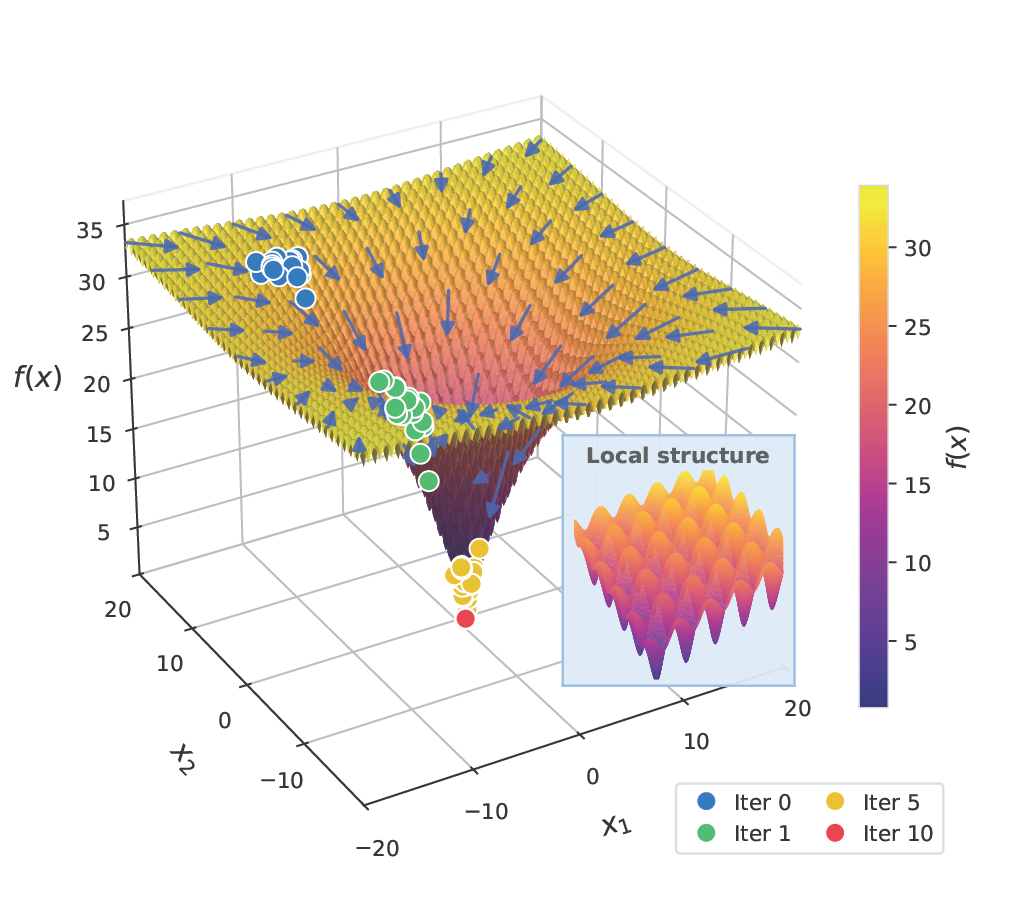
Solve unconstrained optimization problems from a given problem class
\[ \min_{x\in\mathbb{R}^n} f(x) \]We wish to learn a model that transforms populations of points
\[ \mathcal{X}^{k+1} = \mathcal{T}(\mathcal{X}^k,\, c^k) \]Represent via a velocity field ODE that operates on the populations
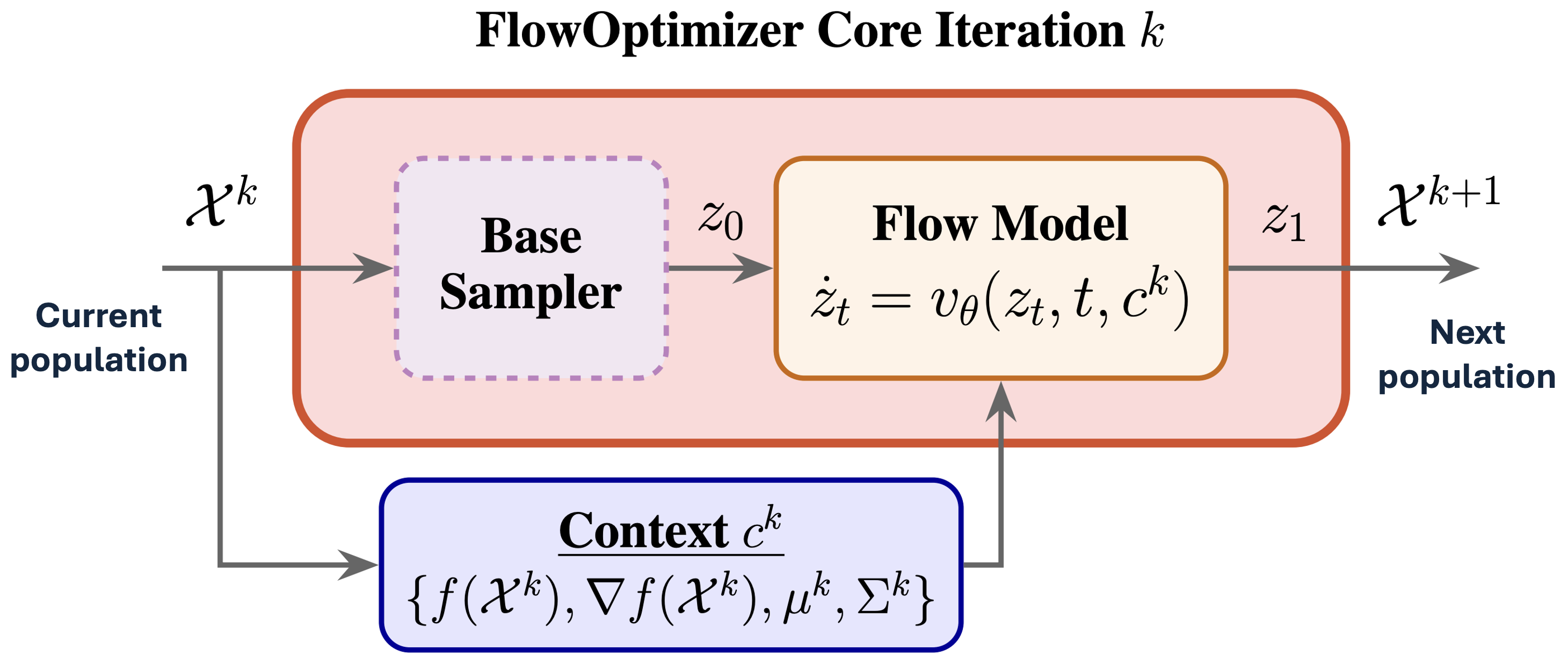
\[ \dot{z}_t = v_\theta(z_t,\, t,\, c^k), \quad z_{t=0}=\mathcal{X}^k \]Velocity field NN is conditioned on population objectives, ranking, gradient information, population statistics, etc.
Velocity field is parametrized with a self-attention architecture that operates jointly on the population state and the local context
Flow matching loss to match displacements to improved populations
\[ \mathcal{L}_{\mathrm{FM}} = \mathbb{E}_{t,z_0,z_1}\, \lVert v_\theta(z_t,t,c) - \Delta z \rVert_2^2 \]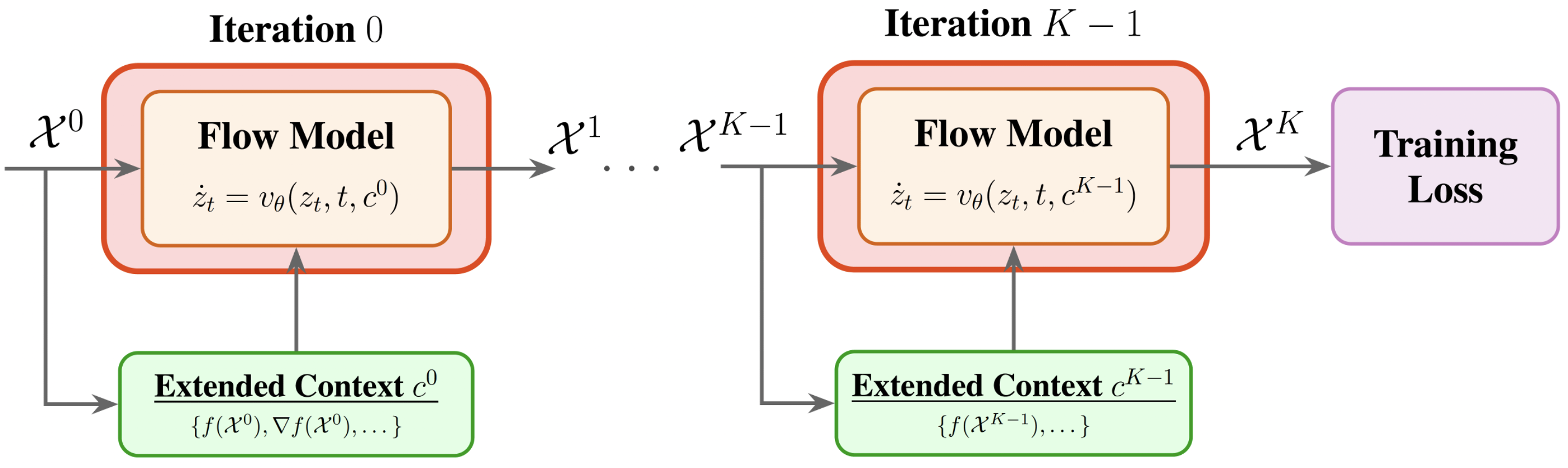
Unroll FlowOptimizer for \(K\) iterations as sequential layers.
Extended context including history of best points, population statistics history, etc.
Training loss directly minimizes the weighted sum of all iteration objectives
\[ \mathcal{L}_{\mathrm{FT}} = \sum_{k=1}^{K} w_k\, \ell_k(\mathcal{X}^k) \]Combines mean and best-sample (softmin) values of populations
\[ \begin{aligned} \ell_k(\mathcal{X}^k) = {}&\alpha\,\mathrm{Best}\big(f(\mathcal{X}_k)\big) \\ &+ (1-\alpha)\,\mathrm{Mean}\big(f(\mathcal{X}_k)\big) \end{aligned} \]Training happens in a self-supervised manner. We only rely on evaluating the populations at each iteration without requiring any known solutions!
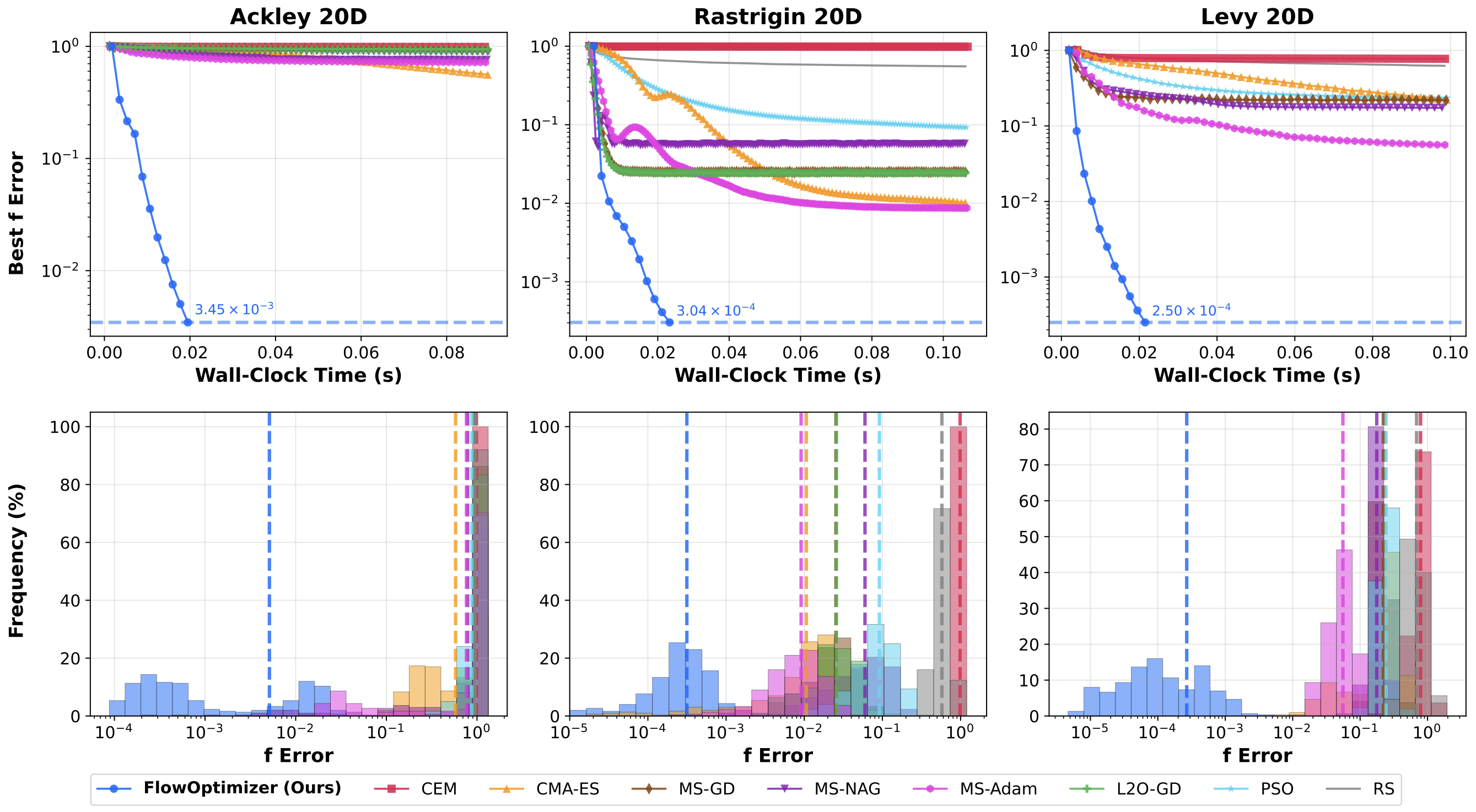
| Problem Class | Dim. \(n\) | FlowOpt (ours) | RS | CEM | CMA-ES | MSGD | MSNAG | MS-Adam | L2O-GD | PSO |
|---|---|---|---|---|---|---|---|---|---|---|
| Robotic Arm | 10 | 0.003 | 0.18 | 0.09 | 0.008 | 0.014 | 0.021 | 0.009 | 0.012 | 0.005 |
| 30 | 0.007 | 0.31 | 0.18 | 0.04 | 0.18 | 0.17 | 0.07 | 0.12 | 0.011 | |
| Power Grid | 20 | 5e-4 | 0.53 | 0.14 | 0.03 | 0.05 | 0.03 | 0.007 | 0.03 | 0.02 |
| 50 | 1.2e-3 | 0.83 | 0.31 | 0.11 | 0.23 | 0.17 | 0.05 | 0.08 | 0.09 | |
| Supply Chain | 40 | 0.007 | 0.47 | 0.09 | 0.05 | 0.07 | 0.03 | 0.02 | 0.013 | 0.02 |
| 80 | 0.013 | 0.68 | 0.14 | 0.06 | 0.09 | 0.03 | 0.02 | 0.027 | 0.03 |
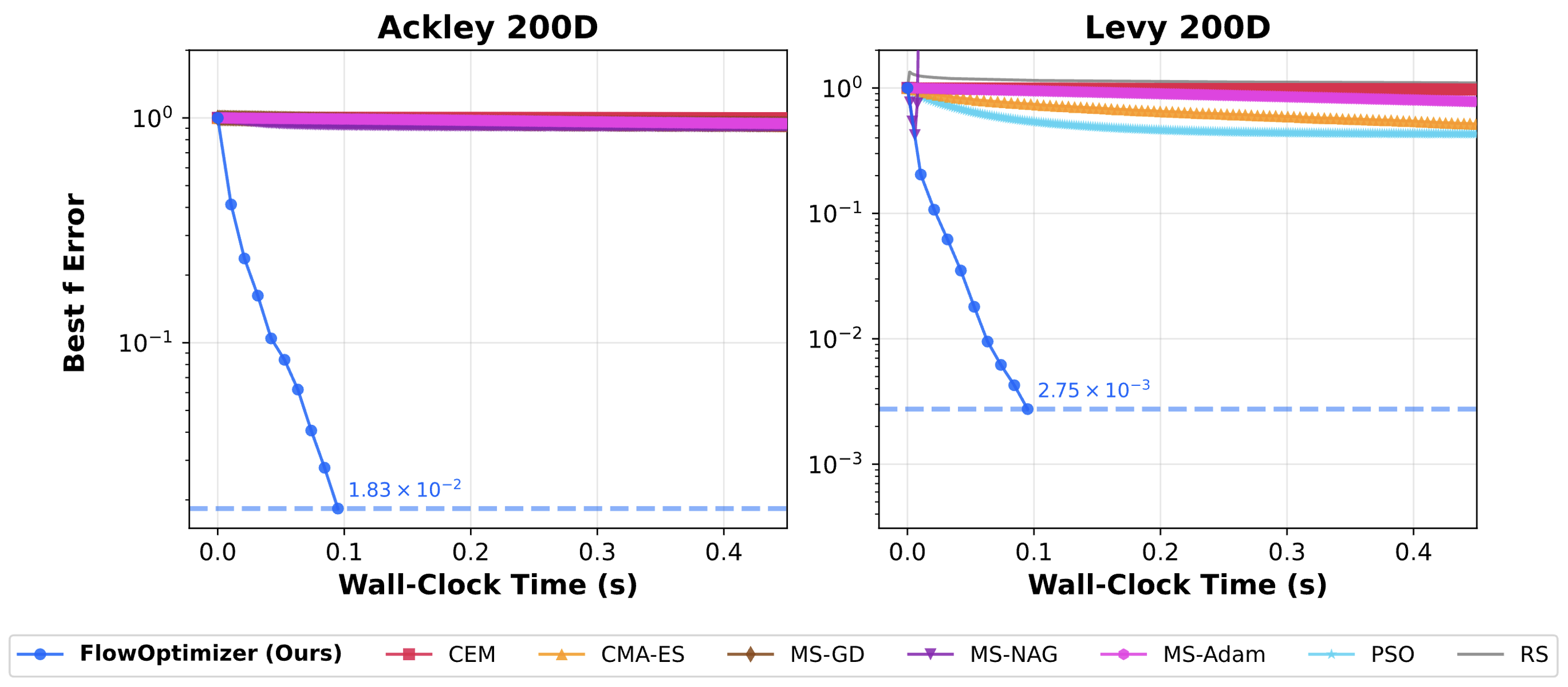
Highly expressive for optimization steps over populations of samples
Learns recurrent patterns of the geometry of the underlying problem class
Operates on populations and learns interactions among members
@inproceedings{
saravanos2026learningtooptimize,
title={Learning-to-Optimize via Deep Unfolded Flows},
author={Augustinos D Saravanos and Oswin So and H M Sabbir Ahmad and Chuchu Fan},
booktitle={Forty-third International Conference on Machine Learning},
year={2026},
url={https://openreview.net/forum?id=ZOtOq7hxJP}
}